tire pressure TESLA MODEL S 2017 (UK) User Guide
[x] Cancel search | Manufacturer: TESLA, Model Year: 2017, Model line: MODEL S, Model: TESLA MODEL S 2017Pages: 186, PDF Size: 4.67 MB
Page 167 of 186

Wheel SpecificationsWheel TypeLocationSizeOffset
19"
Front8.0J x 191.575"
40 mmRear8.0J x 191.575"
40 mm21" - Silver (standard)Front8.5J x 211.575"
40 mm21" - Grey (standard)Rear8.5J x 211.575"
40 mm21" - Silver and Grey (optional) Performance
Plus vehiclesRear9.0J x 211.575"
40 mmRoad Wheel Nut Torque129 lb. ft (175 Nm)Note: For instructions on how to jack/lift Model S, see Jacking and Lifting on page 157.
Tire Specifications
Tire TypeLocationSize19" wheelsAllP245/45R1921" wheelsFront
RearP245/35R21
P265/35R21**On a P85D and P90D Model S, the width of the rear tires may vary depending on date of
manufacture. Some vehicles may be equipped with P245/35R21 tires on both front and rear.Tire pressures vary depending on the type of tires fitted. Refer to the tire pressures printed on
the Tire and Loading Information label. This label is located on the center door pillar and is
visible when the driver
Page 169 of 186
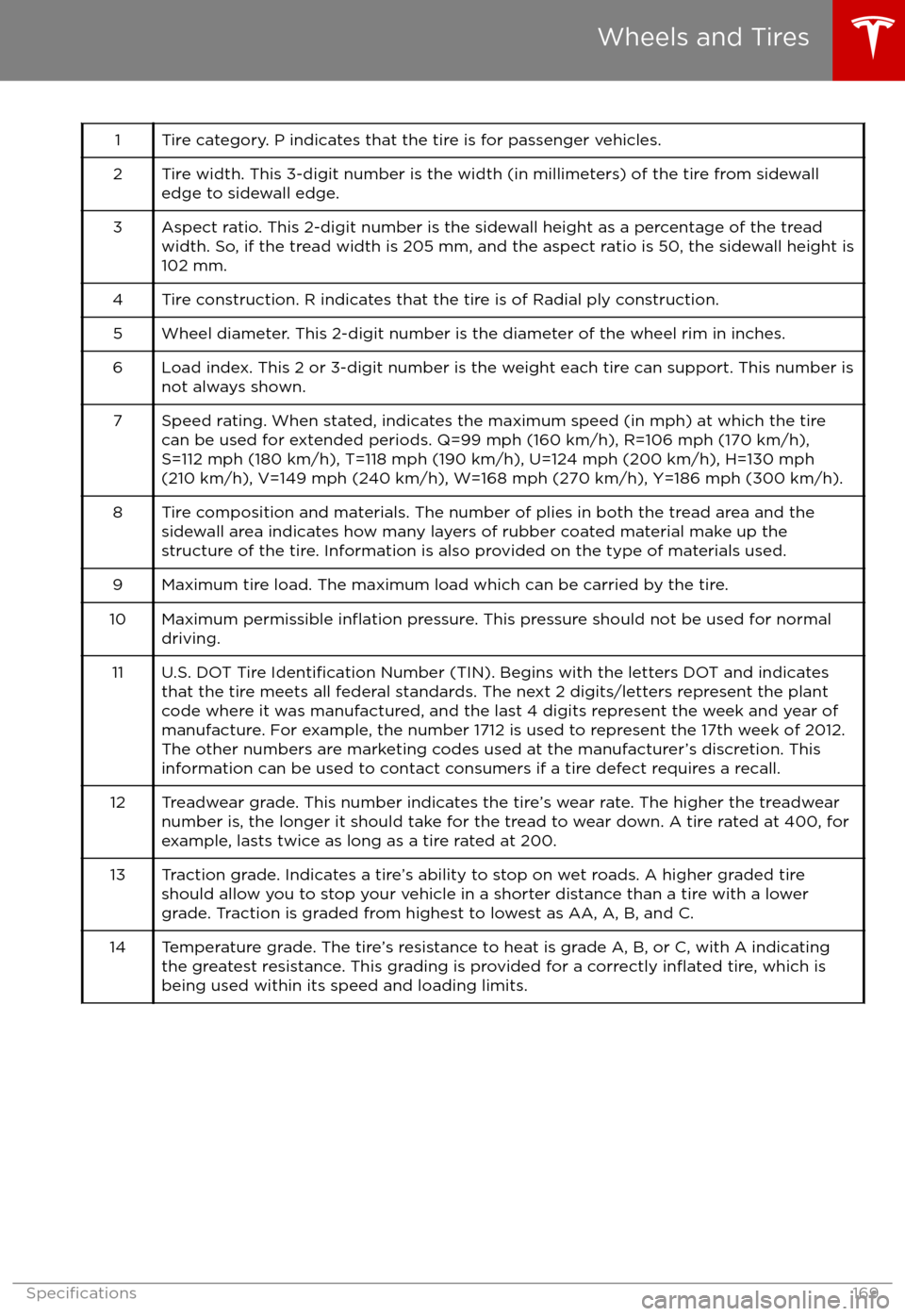
1Tire category. P indicates that the tire is for passenger vehicles.2Tire width. This 3-digit number is the width (in millimeters) of the tire from sidewall
edge to sidewall edge.3Aspect ratio. This 2-digit number is the sidewall height as a percentage of the tread
width. So, if the tread width is 205 mm, and the aspect ratio is 50, the sidewall height is 102 mm.4Tire construction. R indicates that the tire is of Radial ply construction.5Wheel diameter. This 2-digit number is the diameter of the wheel rim in inches.6Load index. This 2 or 3-digit number is the weight each tire can support. This number is
not always shown.7Speed rating. When stated, indicates the maximum speed (in mph) at which the tire can be used for extended periods. Q=99 mph (160 km/h), R=106 mph (170 km/h), S=112 mph (180 km/h), T=118 mph (190 km/h), U=124 mph (200 km/h), H=130 mph(210 km/h), V=149 mph (240 km/h), W=168 mph (270 km/h), Y=186 mph (300 km/h).8Tire composition and materials. The number of plies in both the tread area and thesidewall area indicates how many layers of rubber coated material make up the structure of the tire. Information is also provided on the type of materials used.9Maximum tire load. The maximum load which can be carried by the tire.10Maximum permissible inflation pressure. This pressure should not be used for normal
driving.11U.S. DOT Tire Identification Number (TIN). Begins with the letters DOT and indicates
that the tire meets all federal standards. The next 2 digits/letters represent the plant
code where it was manufactured, and the last 4 digits represent the week and year of
manufacture. For example, the number 1712 is used to represent the 17th week of 2012. The other numbers are marketing codes used at the manufacturer
Page 180 of 186

Article XIV: The use of low-power radio-
frequency devices shall not influence aircraft
security and interfere with legal
communications; interference phenomenon discovered over time, should be immediately
suspended, and improved to no interference before use can continue. Legal
communications, referring to the provisions of
the Telecommunications Act of radio
communications operations. Low-power radio
communications shall tolerate radio wave
interference from radiated devices, legal or
industrial,
scientific and medical.
Tire Pressure Monitoring System FCC IDs: TZSTPMS201, Z9F-201FS43X
IC ID: 11852A-201FS4X
The tire pressure monitoring system (TPMS)
complies with Part 15 of the FCC rules and
RSS-210 of Industry Canada. Operation is
subject to the following two conditions:
1. This device may not cause harmful interference, and
2. This device must accept any interference received, including interference that may
cause undesired operation.
Changes or
modifications not expressly
approved by Tesla could void the user
Page 185 of 186

steering wheeladjusting position 39
adjusting sensitivity 39
buttons 39
heated 39
scroll bars 39
steering, automatic 76
summer tires 142
Summon 81
sunroof 15
suspension 111
suspension
specifications 165
T
telematics 177
temperatureBattery (high voltage), limits 133
cabin, controls for 105
heated steering wheel 41
outside 45
tie-down straps 174
tilt detection 125
Tire and Loading Information label 160
tire noise 142
Tire Pressure Monitoring SystemFCC certification 180
overview of 143
tire pressures, checking 139
tire repair kitinflating with air only 147inflating with sealant 146
replacing the sealant canister 148tiresall-season 142
balancing 140
chains 142
inspecting and maintaining 140
pressures, how to check 139
replacing 141
replacing a tire sensor 143
rotation 140
specification 167
summer 142
tire markings 168
tire sealant 145
winter 142
toll system transponders, attaching 158
tolls, avoiding 120
torque
specifications 164
touch up body 151
touchscreenclean mode 150
cleaning 150
Controls 98
overview 93
Settings 101
software updates 129Tow mode 173
towing 173
towing a trailer 161
towing eye, locating 174
towing instructions 173TPMSFCC certification 180
overview of 143
traction control 59
trademarks 175, 176
Traffic-Aware Cruise Control 70Traffic-Based Routing 120
trailer hitches 161
transmission
specifications 164
transponders, attaching 158
transporting 173
trip chart 65
trip meter 64
trip overview 120
trip planner 120
trunk, front 12
trunk, rearchild protection lock 7
disabling interior handle 7
TuneIn radio 114
turn signals 54
Typical range 101
U ultrasonic sensors 68
Unlock on Park 4
unlockingtrunk, front 12
trunk, rear 10
unlocking and locking doors 4
unlocking when key doesn